
About
A cost reference with nothing to sell you
TreasuryClear publishes what business capital and tax incentive work actually costs. We don't originate loans, broker deals, or prepare returns, and that is the only reason these numbers are worth your time.
Photo: Stephen Leonardi via Pexels
Why this exists
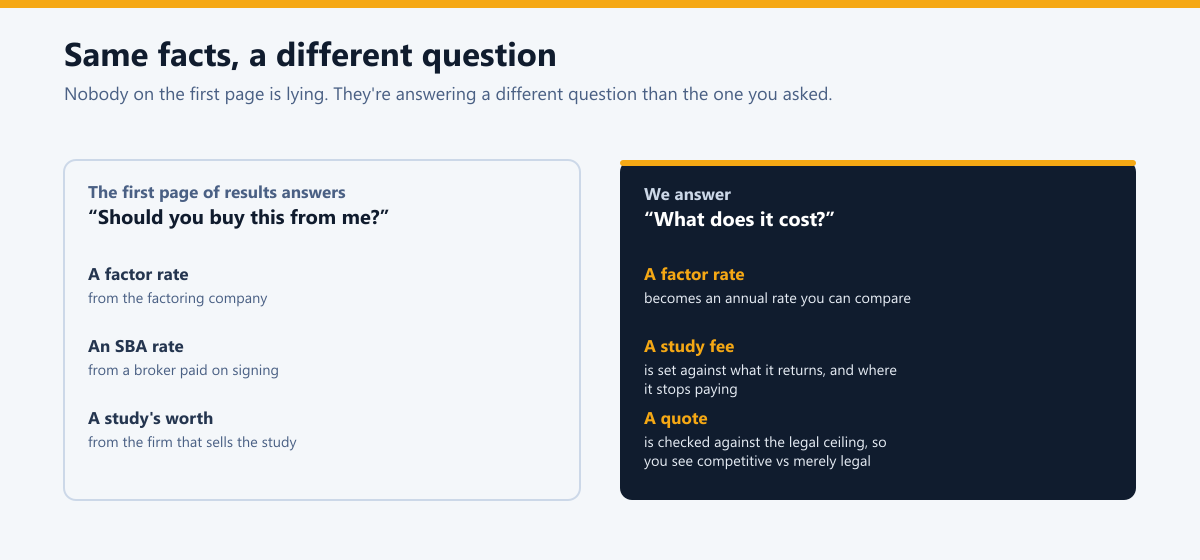
Ask the internet what invoice factoring costs and you get a number from a factoring company. Ask what an SBA 7(a) runs and you get a number from a lender, or from a broker who is paid a share of the origination fee when you sign. Ask whether a cost segregation study is worth it and the answer comes from the firm that sells the study.
None of those people are lying. They are just answering a different question than the one you asked. "What does this cost?" and "should you buy this from me?" produce different pages, and the second one is what the whole first page of results is made of.
So this site answers the first question. A factor rate becomes an annual rate. A study fee gets set against what the study returns, and against the property value where it stops being worth the fee. A quote gets checked against the legal ceiling, so you know whether the number in front of you is competitive, or merely legal.
What we cover
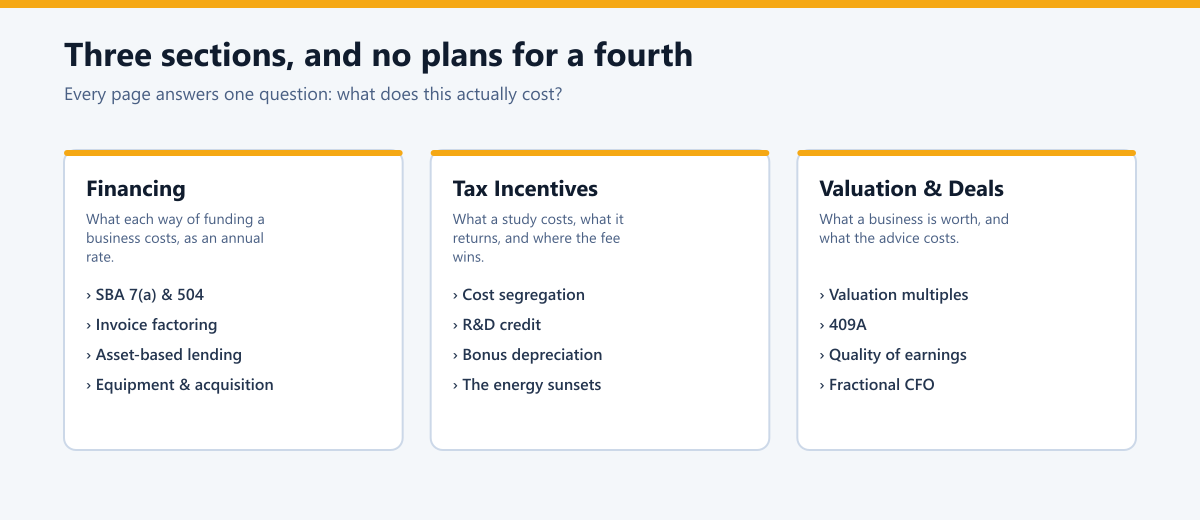
Three sections, and no plans to add a fourth just to have one.
- Financing. What each way of funding a business costs once the quote is converted to an annual rate: invoice factoring, revenue-based financing, asset-based lines, equipment paper, the SBA programs, and acquisition debt.
- Tax incentives. Cost segregation, the R&D credit, hiring credits, and the energy deductions. What the study costs, what it returns, and the point where the fee eats the benefit.
- Valuation and deals. What a business is worth, what 409A work costs, what a quality-of-earnings review actually scopes, and what fractional CFO time goes for. Written for the owner at the table rather than the advisor billing the hour.
How we're paid
By referral, and only from products we would recommend anyway. When a program is live we name the partner in the page you're reading, on the disclosure page, and in the footer of every page on the site. A referral fee never changes what you pay, and it has never bought anyone a recommendation here.
The books on the homepage carry Amazon links, which pay a small commission. They are books we work from. Amazon goes nowhere near the products this site covers, because a commissioned link to a lender is the exact conflict everything above is written to avoid.
There is a rail we refuse. Merchant cash advance pays better than anything else in this niche, and we publish a page telling you to walk away from it. Taking the fee would make that page a lie, so the code that builds our outbound links throws a build error if anyone ever tries. The site will fail to compile before it will sell you an MCA.

Who writes this
TreasuryClear publishes under the brand, not under a byline. That is a deliberate choice, and the reason is in the previous section: a name on a page is not evidence. A rate you can trace to the Federal Reserve's H.15 release, a credit rule you can trace to the section of the Internal Revenue Code it comes from, and a date telling you when someone last opened those sources, are evidence. You can check every one of them without knowing anything about us.
Wikipedia, Consumer Reports, and the ratings agencies all work the same way. The institution is the author. What it cites is the credential.

Tell us when we're wrong
Rates move, programs lapse, and Congress rewrites the credits. A page that was right in March can be wrong by August, which is why every money page on this site carries the date its figures were last checked, and why they get re-read every quarter.
If you find a number that is out of date or simply wrong, that is the message we most want to get: hello@treasuryclear.com. We fix it and say so on the page.