Asset-based lending rates: what an ABL line costs
Asset-based lending prices at prime plus 1% to 5%, plus fees an APR quote hides. How the borrowing base works, the all-in cost, and when an ABL line fits.

Asset-based lending prices at prime plus roughly 1% to 5%, so about 7.75% to 11.75% at today’s 6.75% prime rate, and then fees stack on top of that. It’s a revolving line secured by your receivables, inventory, and equipment, and how much you can draw is set by a borrowing base, a formula that advances a percentage of each eligible asset. The interest rate is the headline, but the fees, an unused-line charge plus collateral monitoring and field exams, are what an APR quote leaves out.
That makes ABL cheaper than a cash advance and more flexible than a term loan, but only if you have the collateral to back it. It’s built for companies with strong receivables or inventory and lumpy cash flow. Here’s how the borrowing base decides your limit, what the line really costs once the fees are in, and when it’s the right tool.
The borrowing base sets your limit
An asset-based line isn’t a fixed loan amount. Your credit limit floats with your collateral, recalculated as your receivables and inventory rise and fall.
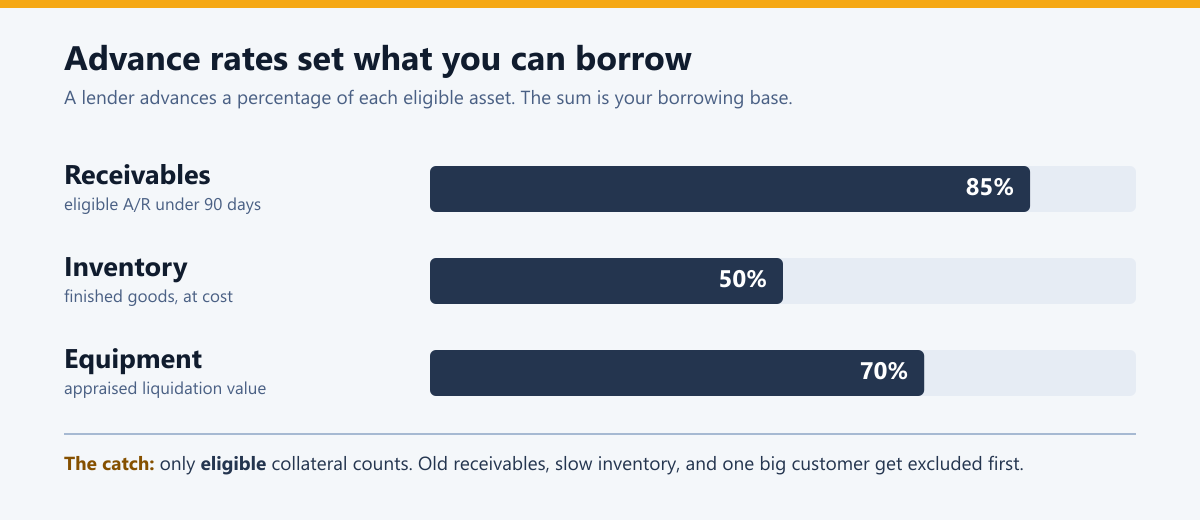
Receivables carry the highest advance rate, commonly 80% to 85% of eligible invoices, because a good invoice is nearly cash. Inventory advances lower, around 50% at cost, since it still has to be sold. Equipment is lent against its appraised liquidation value. Add them up and you get the borrowing base, the ceiling on what you can draw at any moment. The word doing the work is eligible: a lender excludes receivables past 90 days, invoices from a customer who’s also a supplier, inventory that moves slowly, and anything overly concentrated in one account. Your headline collateral and your eligible collateral are rarely the same number.

The rate is only part of the cost
Here’s where an asset-based line gets more expensive than the quoted rate suggests. You pay interest on what you draw, but you also pay fees on the parts you don’t.
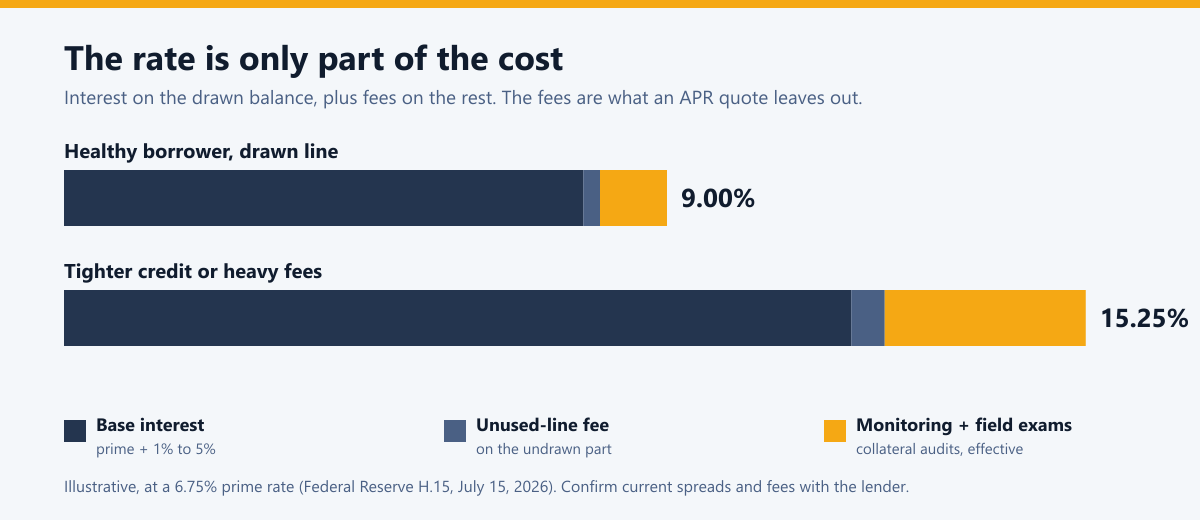
The base interest is prime plus a spread of roughly 1% to 5%, depending on your credit and the quality of your collateral. On top of it sit an unused-line fee, usually a quarter to half a percent on the portion of the facility you haven’t drawn, and the cost of the lender watching its collateral: regular reporting, periodic field exams, and collateral audits. Those monitoring costs are real money and can add one to three effective points, especially on a smaller facility where the fixed exam cost is spread over less borrowing. So a line quoted at 9% can cost noticeably more once the fees are counted. Run your own draw and fees through the true-cost calculator to see the all-in number, because that’s the figure to compare against every other option.
Where ABL fits, and the cheaper doors
Asset-based lending earns its place in a specific spot: you have substantial receivables or inventory, your cash flow is uneven, and you either can’t qualify for cash-flow lending or need more flexibility than a fixed term loan gives. Distressed and turnaround companies lean on it heavily, because a lender will advance against hard collateral even when the earnings look shaky. The line breathes with your business, more availability when sales grow, less when they shrink.
Because it’s still more expensive than bank money, try the cheaper doors first. A bank term loan or an SBA 7(a) prices lower if you can qualify on cash flow. If the issue is purely that your cash is locked in receivables, invoice factoring may be simpler, and revenue-based financing fits a business with recurring revenue but few hard assets. Where ABL wins outright is against a merchant cash advance: if that’s the alternative, asset-based lending is cheaper by an order of magnitude. The financing router points you at the cheapest structure you actually qualify for. Your spread, your advance rates, and the monitoring fees all come from the lender and all are negotiable, so treat the figures here as the bracket to negotiate inside rather than a quote. The two worth pushing hardest on are the advance rate on receivables, which sets how much you can actually draw, and the field-exam schedule, which is where a small facility quietly gets expensive.