Invoice factoring cost: the fee is not the rate
Invoice factoring runs 1% to 5% per invoice, but that fee is not an interest rate. Convert it to an APR and a typical deal lands near 24%. Here is the real math.

Invoice factoring costs 1% to 5% of each invoice you sell, most often 1.5% to 3.5%, and that number is quoted as a fee rather than an interest rate for a reason. A 2.5% fee on a net-30 invoice is not 2.5% a year. Annualize it and a typical factoring deal lands near 24%, because you only had the money for the weeks until your customer paid.
That gap between the fee you’re quoted and the rate you actually pay is the whole game. Factoring can be a reasonable tool for a business with slow-paying customers and no other line of credit. It can also be quietly expensive money dressed up as a small percentage. The only way to tell which one you’re being offered is to do the conversion the factor won’t do for you.
What you actually pay, on a real invoice
Factoring is not a loan. A factor buys your unpaid invoice at a discount and collects it themselves. Two numbers set the cost: the advance rate, which is how much you get up front, and the factoring fee, which is what you give up.
Advance rates typically run 70% to 90% of the invoice’s face value. The rest is held back in a reserve. When your customer pays the factor, you get the reserve back, minus the fee. So on a $10,000 invoice at an 85% advance and a 2.5% fee, you receive $8,500 today, then $1,250 when the invoice clears, and the factor keeps $250.
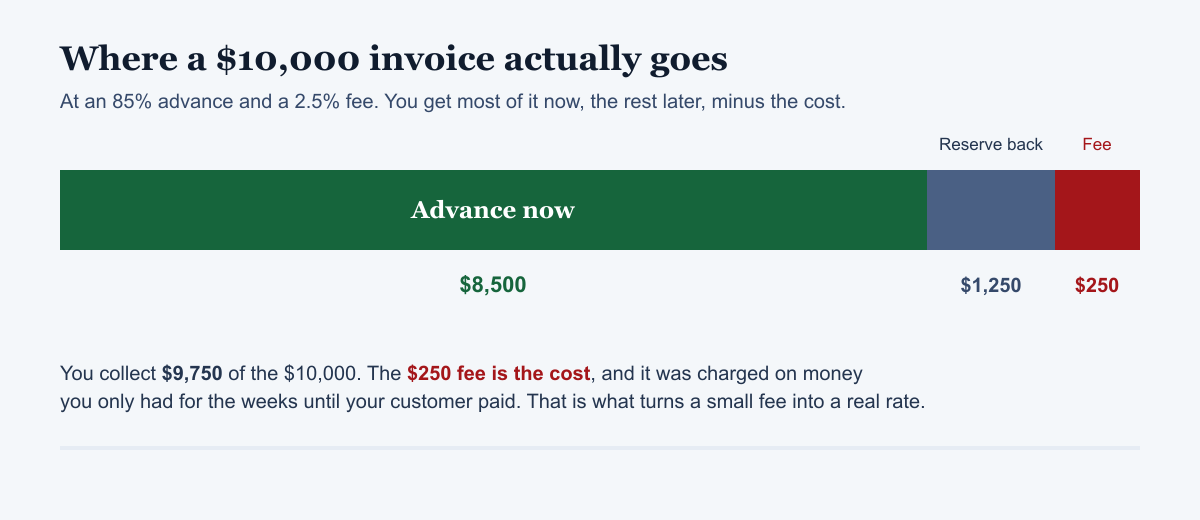
That $250 looks small next to a $10,000 invoice. It is 2.5%. The problem is what happens when you turn 2.5% for a few weeks into a number you can compare against a bank line or an SBA loan.
Turning the fee into a rate
An interest rate is annual by definition. A factoring fee is not, so comparing the two directly is comparing a sprint time to a marathon pace. To make them comparable, you annualize the fee: divide it by the collection period, then scale it up to a full year.
Take the $250 fee on money you advanced against for 45 days until the customer paid. As a rate on the cash you actually received, annualized across a year, that works out to roughly 24%. The fee never changed. The way it’s quoted just hid the rate inside a short window.
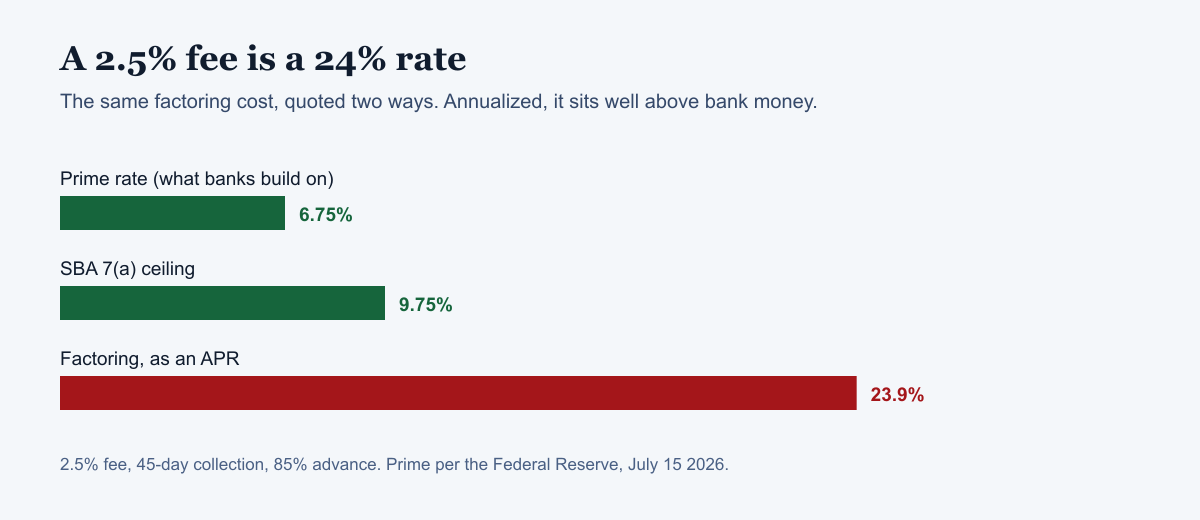
Our true-cost calculator does this conversion for you: type in the fee, the advance rate, and how long your customers take to pay, and it returns the APR. The point of running it is not to prove factoring is bad. It’s to give you one honest number you can hold next to every other financing option instead of a fee that was designed to look smaller than it is.
When factoring is the right call anyway
A 24% APR is expensive next to a bank line at prime plus a couple of points. It is cheap next to a merchant cash advance, which routinely runs past 100%. Factoring lives in the middle, and the businesses it fits share a shape: they invoice commercial customers on net-30 to net-90 terms, they need the cash before those invoices clear, and they can’t get a conventional line of credit yet, often because they’re young or growing too fast for their balance sheet.
Freight is the classic case. A trucking company runs loads today and gets paid in 30 to 60 days, but fuel and drivers can’t wait. Factoring turns a delivered load into cash the same week. The rate is high, but the alternative isn’t a cheaper loan, it’s not taking the load at all.

The test is not whether factoring is cheap. It isn’t. The test is whether the cash it frees up earns you more than the fee costs, and whether you have a cheaper option you’re skipping. If a bank will give you a line at prime plus three, take the line. If nobody will, and the work in front of you pays, factoring can be worth 24%.
The costs the headline rate hides
The fee is only the part they quote. Before you sign, price the rest, because a low advertised rate with a stack of add-ons can cost more than a higher honest one.
Watch for monthly minimums, which charge you whether or not you factor enough volume. Watch for tiered fees that climb the longer your customer takes to pay, so a 1% teaser becomes 3% at 60 days. Watch for whether the factor charges the fee on the full invoice or just the advance, and whether the arrangement is recourse, meaning you buy the invoice back if your customer never pays. And read the termination clause: some contracts lock you in for a year with a stiff exit fee.
None of these show up in the “1% to 5%” you’ll read on a factor’s homepage. All of them belong in the true-cost calculation, and all of them are the kind of detail a page selling factoring has no reason to lead with. We don’t sell it, so we can.
Before you commit to any of it, run the number and see where you land. If factoring is your only option and the math works, use it with your eyes open. If a cheaper structure fits, the financing router will point you at it. Either way, read the agreement for the three terms that decide the real cost: whether it’s recourse or non-recourse, how the reserve is released, and what the minimum monthly volume commitment is. A low headline rate attached to a high monthly minimum is how a cheap-looking facility turns expensive in a slow quarter.