Merchant cash advance APR: what 1.4 really costs
A merchant cash advance quotes a factor rate, not an APR. A 1.4 factor over six months is about a 142% annual rate. Here is the math, and the way out.

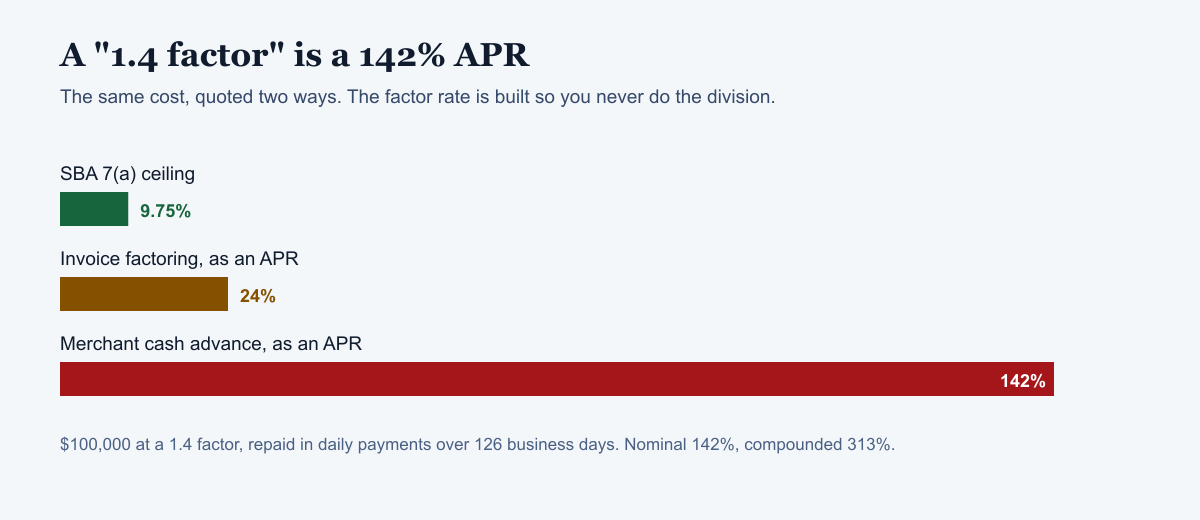
A merchant cash advance doesn’t quote you an interest rate, it quotes a factor rate, and the two are not the same thing. A factor of 1.4 means you repay $1.40 for every dollar you take. On $100,000 advanced and repaid in daily payments over about six months, that works out to roughly a 142% annual rate, or 313% once you compound it. The 1.4 is designed so you never do that division.
This is the most expensive money most small businesses will ever be offered, and it’s offered the most aggressively, precisely because it’s the most profitable to sell. If you’re being pitched one, the useful thing is not a pep talk, it’s the real number and a list of cheaper options. Both are below.
The factor rate is not a rate
An interest rate accrues on what you still owe, so it falls as you pay down the balance. A factor rate does none of that. It’s a flat multiple set the day you sign: 1.4 times the advance, full stop, whether you take a year to repay or two months. There’s no benefit to paying early, because the cost was fixed at the start.
Then there’s the daily draw. An MCA takes a fixed slice of your revenue every business day, starting the day after funding. So you never actually get to use most of the money for most of the term, which is exactly what an annual rate is supposed to measure.
Where 142% comes from
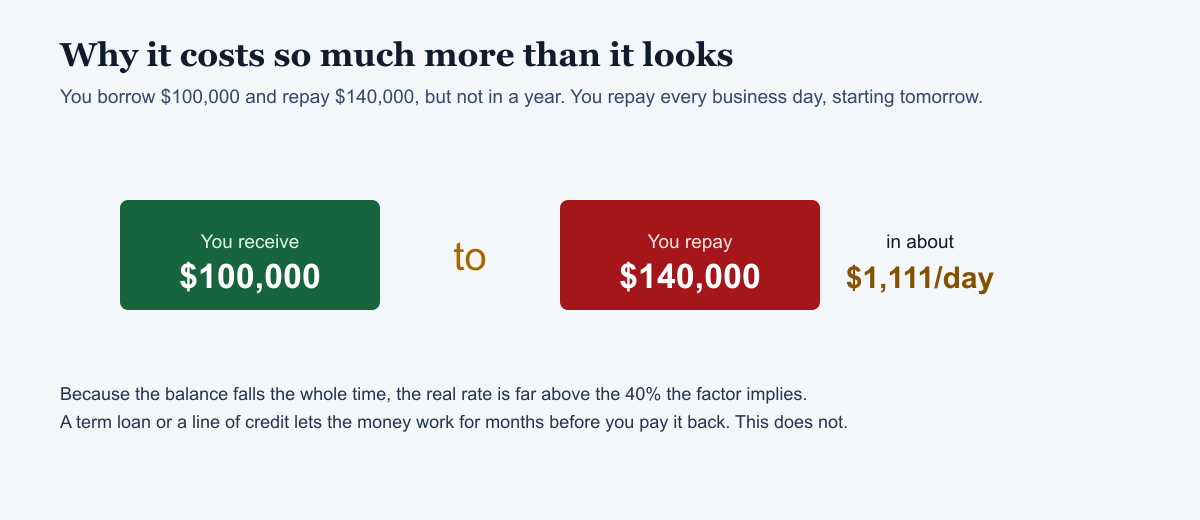
Take the standard deal: $100,000 advanced, $140,000 to repay, collected in equal payments across about 126 business days. That’s roughly $1,111 every business day. To find the real rate, you solve for the rate that discounts that stream of daily payments back to the $100,000 you actually received, then annualize it. The answer is about 142% nominal, and 313% if you compound.
The factor rate implies the cost is 40%. It isn’t, because 40% would be the cost if you held all $100,000 for a full year. You don’t. You start giving it back tomorrow.
You don’t have to take our arithmetic on faith. Put your own advance amount, factor rate, and repayment term into the true-cost calculator and it returns the APR. It runs in your browser and nothing is submitted, which is the opposite of the “apply to see your rate” forms that exist to sell your number to a broker.

The way out is a cheaper structure, not a second advance
The single most dangerous move in this whole market is stacking: taking a second MCA to make the payments on the first. It feels like relief for about three weeks, and then two daily draws are hitting the same shrinking revenue, and the math becomes unsurvivable. It is the most common way a business that could have been saved isn’t.
The way out is to refinance into something, anything, that costs less, and almost everything costs less. A bank term loan or an SBA 7(a) prices in the teens or lower. An asset-based line or invoice factoring can turn your receivables into cash at a fraction of an MCA’s rate. Even a high-rate term loan at 30% is less than a quarter of the cost of the advance you’re trying to escape.

If you already have an advance and the daily debit is choking the business, the move is refinancing into a term structure, not stacking a second advance on the first. Stacking is what turns a bad quarter into an insolvency, and it is exactly what the broker who sold you the first one will suggest. Start with the financing router to find the cheapest structure you actually qualify for, and if a bank or SBA lender will take you at all, take them. Your own terms depend on your business, so confirm them with a professional before you sign.