SBA 7(a) interest rates: the 2026 legal ceiling
SBA caps how far over prime a 7(a) lender can charge. In 2026 the maximum runs from 9.75% on large loans to 13.25% on small ones. Here is the full table.

The SBA doesn’t set 7(a) interest rates, it caps them. A lender adds a spread over a base rate like the prime rate, and the SBA limits how large that spread can be, on a sliding scale by loan size. As of July 2026, with prime at 6.75%, the maximum variable rate runs from 9.75% on loans over $350,000 up to 13.25% on loans of $50,000 or less.
That word “maximum” is the one to hold onto. Every rate below is a ceiling, not a quote. A good lender competing for a strong borrower comes in under it, sometimes well under. A broker quoting you the top of the range and calling it “the SBA rate” is quoting their own margin, not a number the SBA handed down.
The ceiling, by loan size
SBA sets a wider cap on smaller loans, because a $40,000 loan costs a lender about as much to underwrite as a $400,000 one but earns far less interest. So the spread allowance climbs as the loan shrinks. Here is the full table at today’s prime.
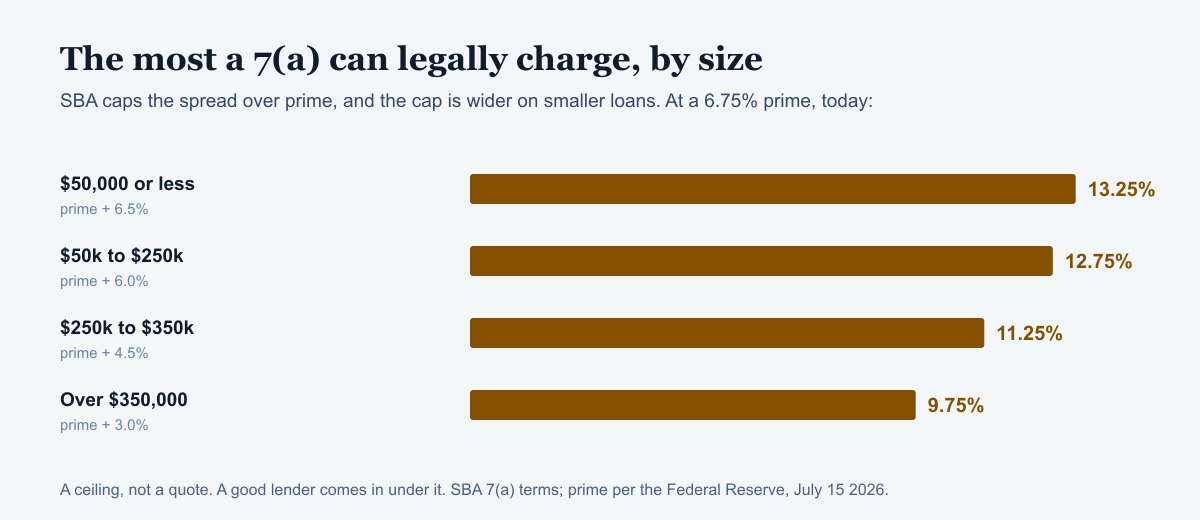
Read it as prime plus a spread: prime + 6.5% under $50,000, prime + 6.0% from $50,001 to $250,000, prime + 4.5% from $250,001 to $350,000, and prime + 3.0% over $350,000. When prime moves, every ceiling moves with it, which is why a rate you read in an old article is almost certainly wrong now.
How your actual rate gets built
A variable 7(a) rate is two numbers added together. The base rate, almost always the prime rate the Federal Reserve publishes, which was 6.75% in mid-July 2026. And the lender’s spread, anywhere from a competitive margin up to the SBA cap for your loan size.
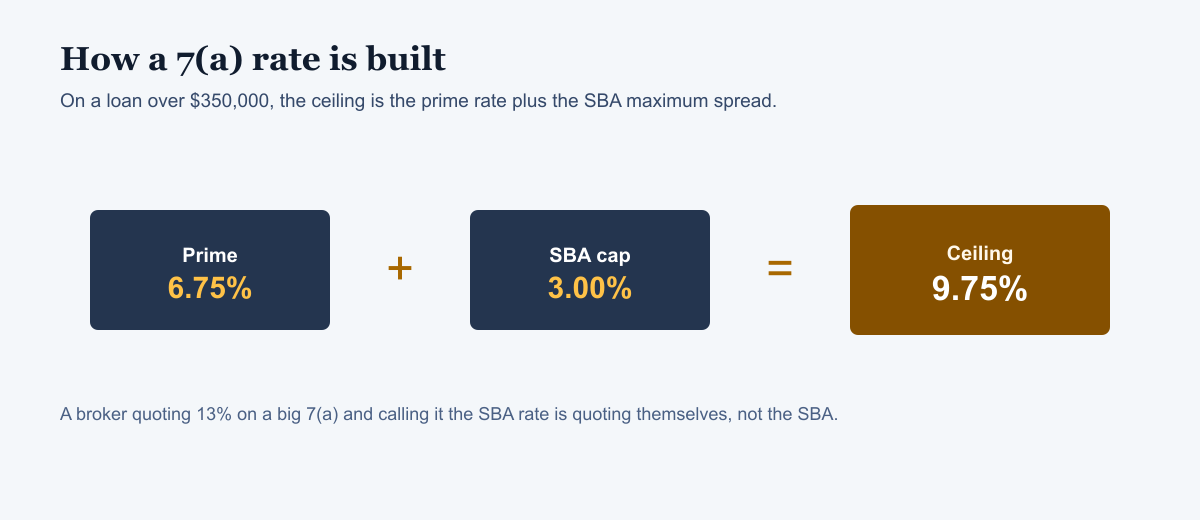
The base rate is the same for everyone. The spread is where your credit, your collateral, your time in business, and your negotiating position actually show up. Two businesses can walk into the same bank the same week and leave with different rates on the same program, and both can be legitimate. What neither can legally exceed is the ceiling for their loan size.
What “average” misses, and what to do instead
People search for the average 7(a) rate hoping for one number to check an offer against. There isn’t one that means much, because the rate depends on your loan size, your file, and the base rate on the day you close. An average blends a strong borrower’s large loan with a marginal borrower’s small one, and tells you nothing about your own deal.
The useful number is your ceiling, and then how far under it you can push. Run your loan amount and a rate through the SBA payment calculator: it fills the rate box with the legal maximum for your size, so you can see the payment at the ceiling and then watch it drop as you enter a real, lower quote. That gives you a target to negotiate toward instead of a stale average to guess against.

If the 7(a) isn’t the right structure, the financing router will point you at what is, and the rest of the financing section covers the alternatives. Confirm your own rate with the lender. The number worth negotiating is the spread, not the base: prime moves for everyone, but the margin on top is the lender’s choice, and on a strong file it is very often well under the cap. Ask two SBA-preferred lenders for the same loan and compare their spreads directly; the gap between them is money you keep for the life of the loan.