Cost segregation study cost, and when it pays
A cost segregation study runs $5,000 to $15,000 and can free a six-figure first-year deduction with 100% bonus back in 2026. When it pays, and when to skip it.
A cost segregation study costs $5,000 to $15,000, and in 2026 it can free a six-figure first-year tax deduction, because the One Big Beautiful Bill restored 100% bonus depreciation. Whether that trade is worth it comes down to one comparison: the study fee against the tax benefit it produces, which depends on your building basis, your tax rate, and how long you plan to hold the property.
The short version: above roughly $500,000 of building basis it usually pays, often handily. Below that, a fixed study fee can eat too much of a modest benefit to bother. Everything else on this page is how to tell where your own numbers land.
What a study actually does
To the tax code, a commercial building is one asset you depreciate over 39 years, a residential rental over 27.5. That’s slow. But a building isn’t really one thing. It’s a structural shell plus a lot of shorter-lived parts: the special-purpose electrical, the fixtures and finishes, the parking and landscaping.
A cost segregation study is an engineering analysis that identifies those parts and reclassifies them into their true 5, 7, and 15-year classes. And here’s why 2026 matters: short-life property qualifies for bonus depreciation, which is back to 100%. So the parts a study carves out can be expensed in year one instead of bled out over four decades.
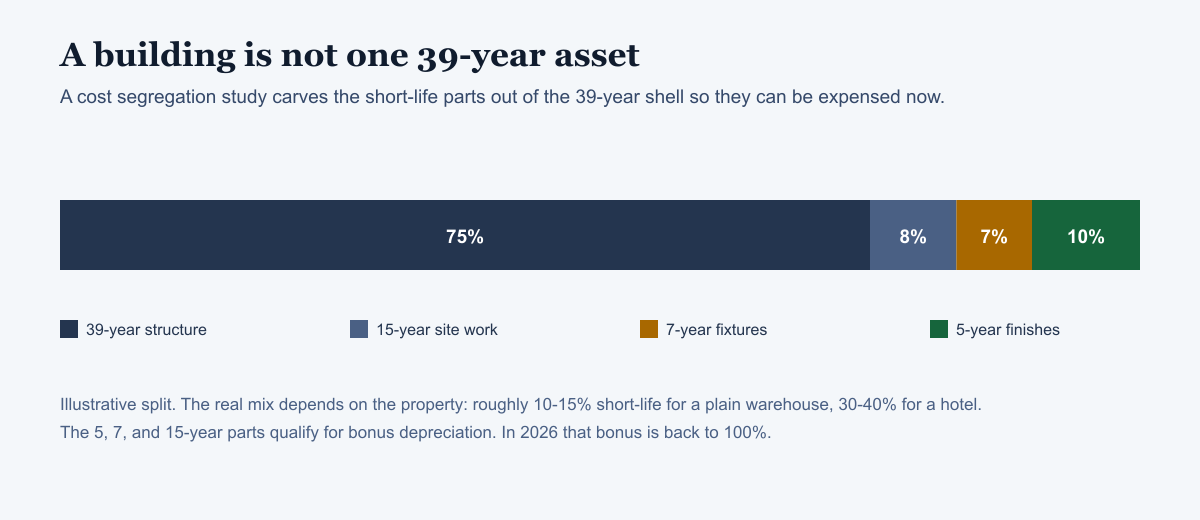
How big that short-life slice is depends entirely on the property. A plain warehouse might reclassify 10% to 15%. An apartment building or an office runs 20% to 30%. A hotel or a restaurant, with all its special-purpose systems, can hit 30% to 40%. The study is what determines your actual percentage, which is also why a real engineering study beats a rule-of-thumb guess.
The number that decides it
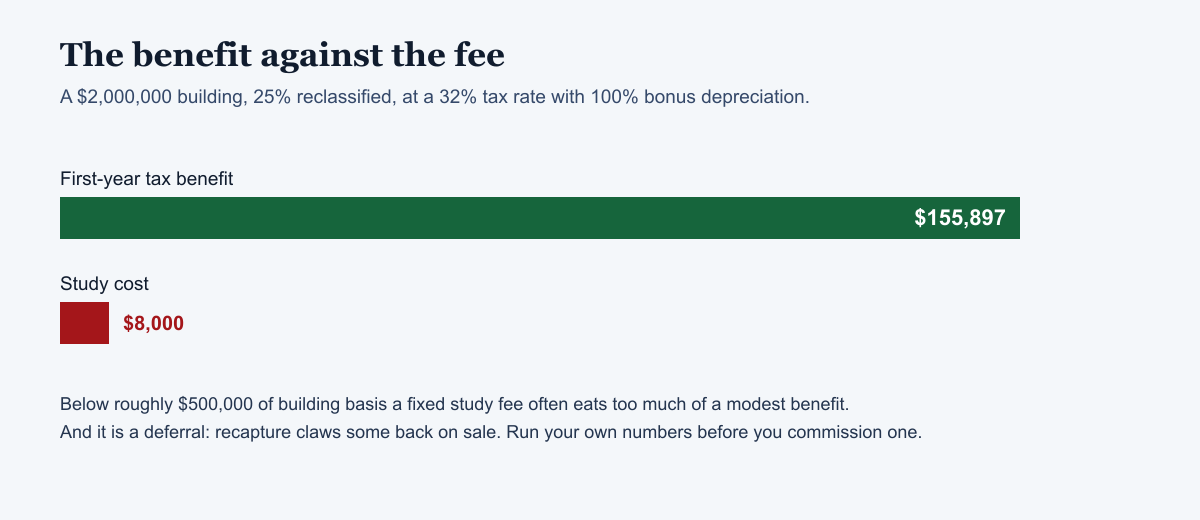
Put the pieces together on a real building. Take $2,000,000 of basis, a study that reclassifies 25% into short-life property, a 32% combined tax rate, and 100% bonus. The reclassified $500,000 gets expensed in year one, and against straight-line that pulls a first-year tax benefit near $155,000. Set that against an $8,000 study, and the study pays for itself many times over.
Run your own building through the cost segregation calculator: it takes your basis, your reclassification percentage, your tax rate, and the bonus rate, and shows the first-year benefit against a study fee you enter. That’s the honest way to answer “is it worth it,” because the answer is entirely a function of your numbers, not a slogan.
The part the study firms lead past
Two things temper the pitch, and neither is on a cost-seg firm’s homepage.
First, it’s a deferral, not a discount. Expensing the short-life property now means those parts have nothing left to depreciate later, so future years lose the deduction. And on sale, depreciation recapture taxes some of the benefit back. The real economic gain is the time value of holding that tax money in the meantime, which is large if you’ll own the building for years and small if you’re about to sell.
Second, the fee is fixed but the benefit scales, so small properties are where the math gets marginal. Below about $500,000 of basis, an $8,000 study can eat a big share of a modest benefit, especially if your tax rate is low. That’s the case where the honest answer is to skip it.
If the numbers clear the fee with room to spare, an engineering-based study documents the reclassification well enough to hold up on audit, which a rule-of-thumb estimate can’t. If they don’t, you’ve saved yourself the fee. Either way, run the calculator first, and read the rest of the tax incentives section for the deductions that stack with it. This is an estimate and a summary, not tax advice: a real study and your CPA make the call.