R&D tax credit: rate, rules, and study cost
The federal R&D credit is 14% of qualified research spend above a base, or 6% first-time. What it is worth, what qualifies, and whether a study pays.
The federal R&D tax credit is worth 14% of your qualified research spending above a base amount, or a flat 6% if you’ve never claimed it before. On a company spending $600,000 on qualifying research this year against a $200,000 base, that’s a $56,000 credit, a dollar-for-dollar reduction of tax owed, not just a deduction. The catch is that it rewards increases in research spending, not steady spending, and the definition of “qualifying” is both broader and stricter than most owners assume.
This is one of the most valuable and most misunderstood credits in the code. Businesses that qualify often don’t claim it because they think R&D means a laboratory, and businesses that do claim it sometimes overreach on what counts. Here is the real rate, the real definition, and how to tell what your own claim is worth.
How the credit is calculated
Most companies use the Alternative Simplified Credit, because it doesn’t require reconstructing decades-old financial records. The math is 14% of the research spend that exceeds a base, and the base is half your average qualified spend over the prior three years.
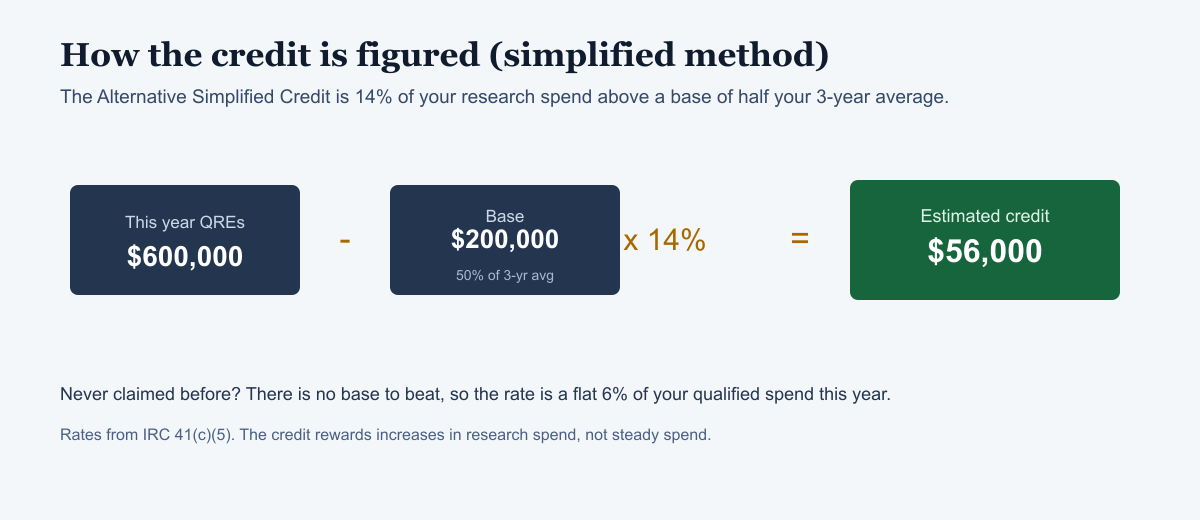
Because the credit only rewards spend above the base, a company with flat research budgets gets less than one that’s ramping up. That’s by design: the credit exists to encourage more research, not to subsidize a steady line item. Run your own numbers through the R&D credit estimate to see where your spending lands against your base.
What actually counts
Qualified research expenses come in three buckets: wages for the people doing, supervising, or directly supporting the research; supplies consumed in the process, including materials for prototypes; and 65% of what you pay outside contractors to do research for you.
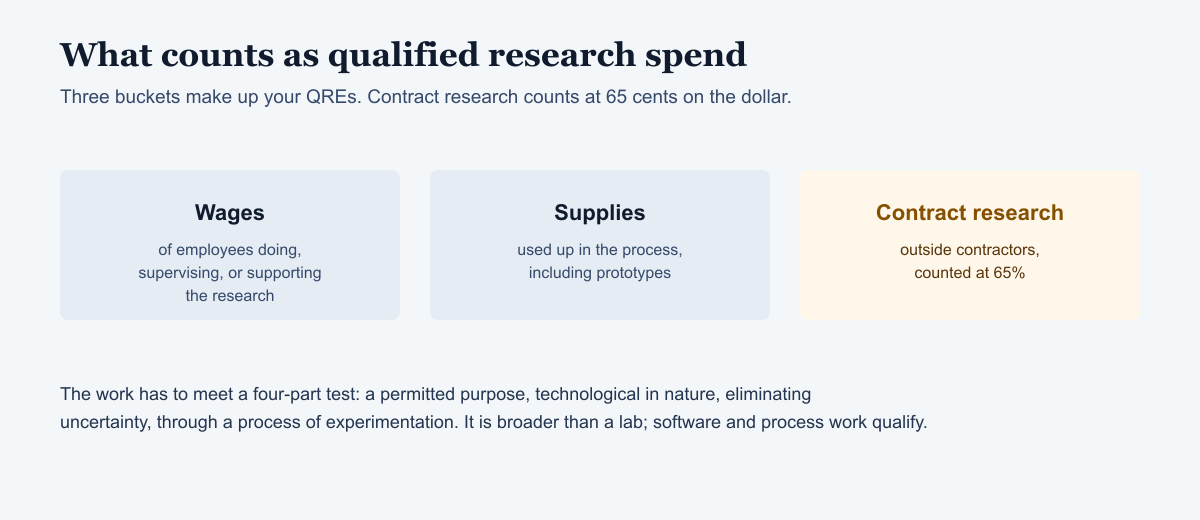
The work itself has to pass a four-part test: it aims at a permitted purpose (a new or improved product, process, or software), it’s technological in nature, it sets out to eliminate uncertainty, and it proceeds through a process of experimentation. That last part is what opens the credit to far more than laboratories. A software team iterating on an architecture, a manufacturer refining a process, a shop designing a new tool, all can qualify.

What a study costs, and the parts to plan around
You can estimate the credit yourself in a minute. Claiming it defensibly is more work, which is what an R&D study buys: it documents which projects and which wages qualify, ties them to the four-part test, and builds the record that survives an audit. A study runs from a few thousand dollars up to a share of the credit, and it earns its fee once the claim is large enough that the documentation matters more than the cost.
Three things change the number you keep, and each depends on your situation, so they belong with your CPA. The Section 280C election trades a smaller credit for keeping your deduction. The payroll-tax offset lets a qualified small business apply up to $500,000 of the credit against payroll taxes instead of income tax, which is the difference-maker for a pre-profit startup. And many states stack their own credit on top of the federal one.
Start with the estimate to see whether the credit is large enough to chase, then read the rest of the tax incentives section for the deductions that pair with it. This is a summary and an estimate, not tax advice: your credit, your election, and your documentation are decisions for a professional who has seen your books.