Business valuation: SDE, EBITDA, and multiples
A business sells for a multiple of its earnings. How SDE and EBITDA differ, what multiple a business earns, and how to size up the number before a sale.

A business is worth a multiple of its earnings, and the whole art of valuing one is getting both numbers right. First you recast earnings the way a buyer sees them, which for a small business means SDE and for a larger one means EBITDA. Then you apply a market multiple, usually around 2 to 3 times SDE for an owner-run business, and higher for a company big enough to run on hired management. On $320,000 of recast earnings at a 2 to 3 multiple, that’s a business worth roughly $640,000 to $960,000.
The reason two owners of similar-looking businesses get very different valuations is almost never the earnings. It’s the multiple, and the multiple is where size, growth, and how much the business depends on you all show up. Here is how both numbers are built, and how to size up your own before you ever talk to a broker.
SDE or EBITDA: pick the right earnings first
Both start from profit and add back costs a new owner wouldn’t carry the same way. The difference is a single line, owner pay, and it moves the number a lot.
SDE, seller’s discretionary earnings, adds your entire compensation back in: salary, distributions, benefits, the personal expenses that run through the business. That’s right for a small, owner-operated business, because the buyer is stepping into your seat and your paycheck. EBITDA leaves owner pay out, because a business large enough to need a hired manager comes with a salary the buyer still has to pay someone.
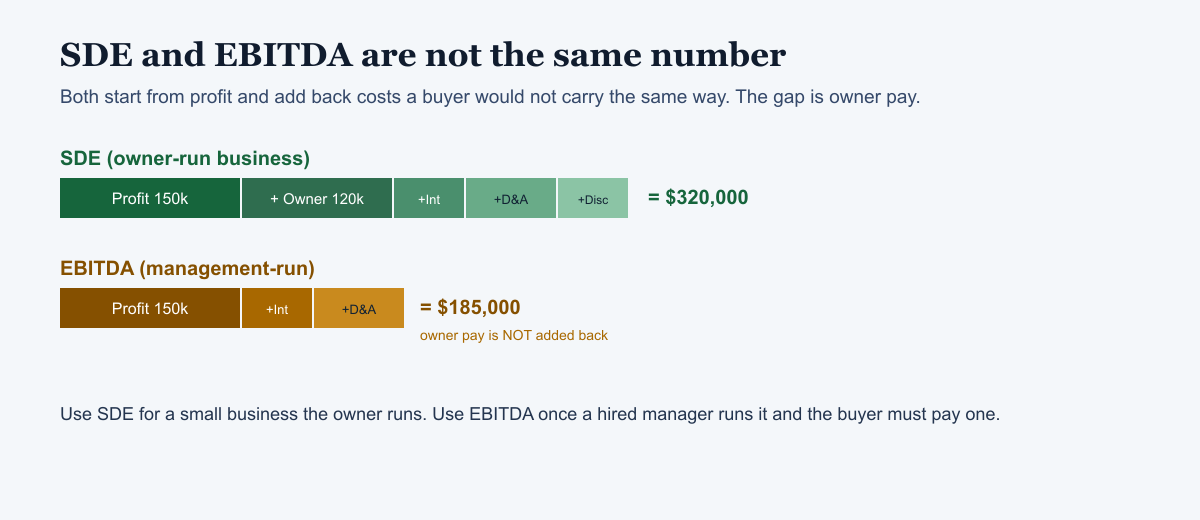
Using the wrong base is the most common valuation mistake owners make. Value a small owner-run shop on EBITDA and you’ll lowball it badly, because you left your own salary out of the earnings a buyer gets back. Value a large management-run company on SDE and you’ll overstate it. Match the base to who actually runs the business.
The multiple is the real variable
Once you have the earnings, the value is earnings times a multiple. Small owner-run businesses commonly sell for about 2 to 3 times SDE. Larger, management-run companies trade on EBITDA multiples that run higher, often 3.5 to 6 times and up. Those are broad market bands from years of recorded small-business sales, not your number.
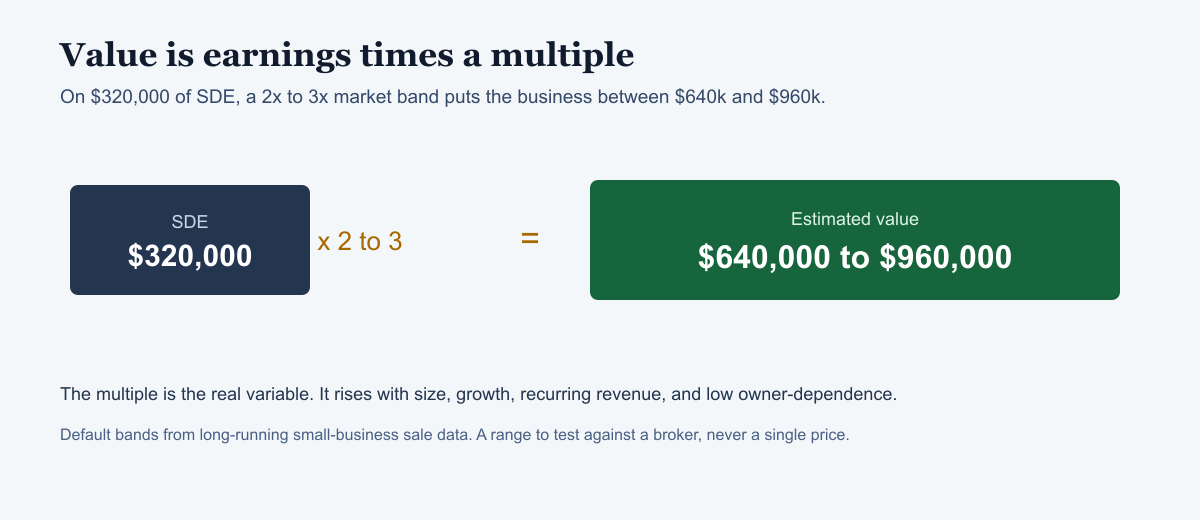
What moves your multiple up: size, because bigger businesses are less risky per dollar of earnings; growth; recurring or contracted revenue; a diversified customer base; and a business that runs without you. What drags it down: heavy dependence on the owner, a single big customer, thin or lumpy margins, and no documented systems. Two businesses with identical SDE can be worth a turn or two apart on those factors alone.
Run your own earnings and a multiple through the business valuation calculator: it takes your recast earnings and a multiple band and returns a range, so you can see how much a half-turn of multiple is worth to you. That’s the number to test, not a single figure to fixate on.

What a calculator can’t do
A multiple-of-earnings estimate is the right way to size up a business and set expectations. It is not the number you take to a closing. A real transaction runs on a professional valuation or a quality-of-earnings review, which digs into whether the earnings are real and sustainable, and on what an actual buyer will actually pay, which is set by the market on the day, not by a formula.
The estimate is most useful for the decisions before that: whether it’s worth going to market, what to fix to lift the multiple, and whether an offer in hand is in the right zip code. If you’re on the buying side instead, the same math tells you whether an asking price is defensible, and the SBA payment calculator prices the acquisition debt behind it, since SBA 7(a) loans are how most small-business purchases get funded.

Start with the calculator to get your range, then read the rest of the valuation section for the deal work that follows. This is an estimate for planning, not a valuation, an appraisal, or advice. A sale, a raise, a buyout, or a dispute needs a qualified professional who has examined your books.