Fractional CFO cost: retainers, hourly, value
A fractional CFO runs $3,000 to $10,000 a month on retainer, or $150 to $500 an hour. What each model buys, and when a business actually needs one.

A fractional CFO costs roughly $3,000 to $10,000 a month on a retainer, or $150 to $500 an hour, depending on how much time you need and how complex your finances are. That buys you senior financial leadership a few days a month, instead of the $250,000-plus a year an experienced CFO commands full time. For a business that has outgrown a bookkeeper but can’t justify a full-time hire, that gap is the entire reason the role exists.
The cost question really has two parts: which pricing model fits the job you need done, and whether your business is at the point where the judgment is worth paying for at all. Both are below.
The three pricing models
Fractional CFOs charge one of three ways, and the right one depends on whether your need is ongoing, narrow, or one-time.
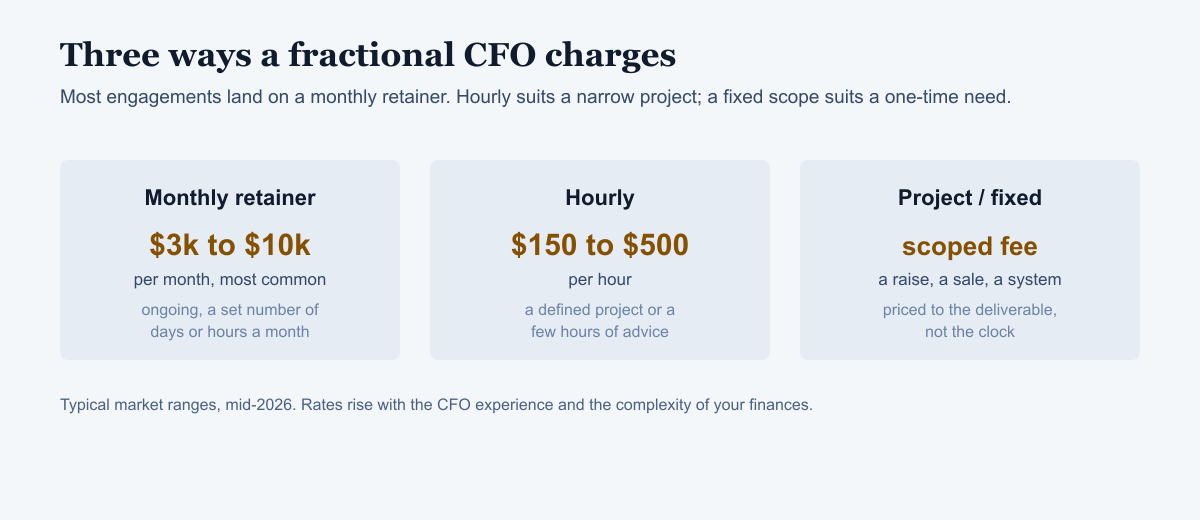
The monthly retainer is the most common because most needs are ongoing: someone to own the forecast, sit in on the hard decisions, and be there when a number looks wrong. Hourly suits a narrow, defined project or a few hours of senior advice. A fixed project fee suits a one-time job with a clear deliverable, priced to the outcome rather than the clock. What moves any of them up is the CFO’s experience and the complexity of your books.

Why fractional is priced the way it is
The whole model exists because a full-time CFO is expensive and most growing businesses don’t need one full time. An experienced CFO is a senior base salary plus bonus and often equity, which all in runs from about $250,000 well past $400,000 a year. A business doing a few million in revenue can’t absorb that and doesn’t need to.
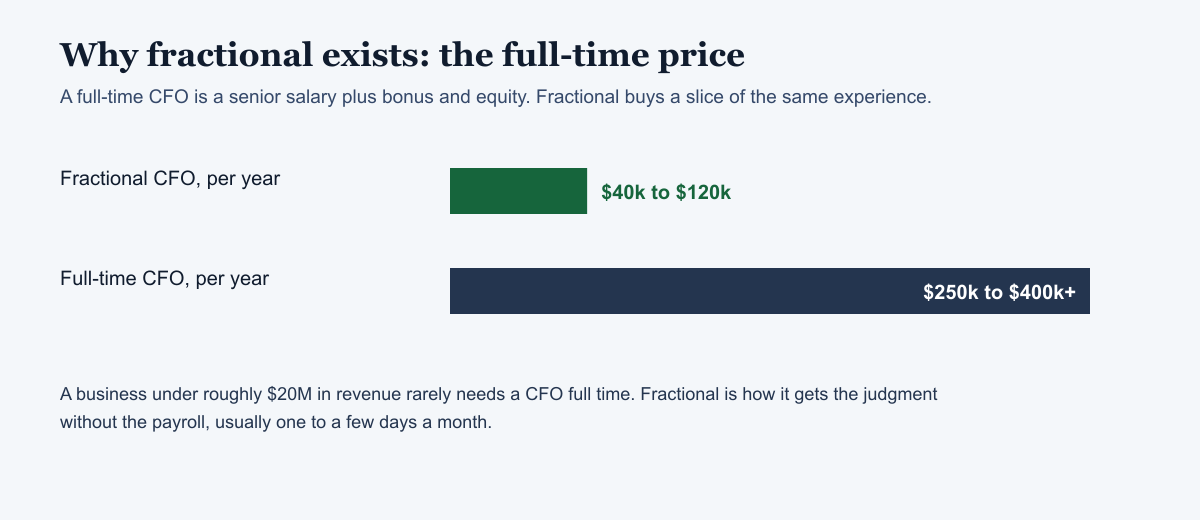
The trigger is usually revenue between roughly $1 million and $20 million, where the financial questions have outgrown a bookkeeper or controller but a full-time CFO salary would be dead weight. Or it’s a specific event: raising capital, selling the business, surviving a cash crunch, or building the financial systems to scale. In each case, the fractional CFO brings the forward-looking layer, strategy, forecasting, capital structure, that a controller who keeps the books accurate isn’t there to provide.

Judging the value, not just the rate
The rate is easy to compare. The value is harder, and it’s the number that matters. A good fractional CFO earns their fee not by saving on payroll but by improving decisions: a cleaner raise at a better valuation, a financing structure that costs less, a forecast that catches a cash crunch a quarter early, a sale prepared well enough to defend a higher price.
That last one is where it pays most directly. If you’re heading toward a sale, the business valuation is the number a fractional CFO is hired to protect and improve, and getting the earnings recast and the story straight before a buyer’s quality of earnings review is exactly the kind of work that returns many times the fee. Read the rest of the valuation section for the deal work around it.
These figures are typical market ranges as of mid-2026, not a quote, and the right arrangement depends on your business and the CFO you hire. This is general information, not financial advice.